Container is one of the key factors in the industry and international transport industry, helps optimize the goods transportation process. So what is a container?? How many types of containers are there?? Let's find out details with Cuong Quoc Logistics through the article below, from basic definitions to common container types and practical applications.
Article Content
What is container?
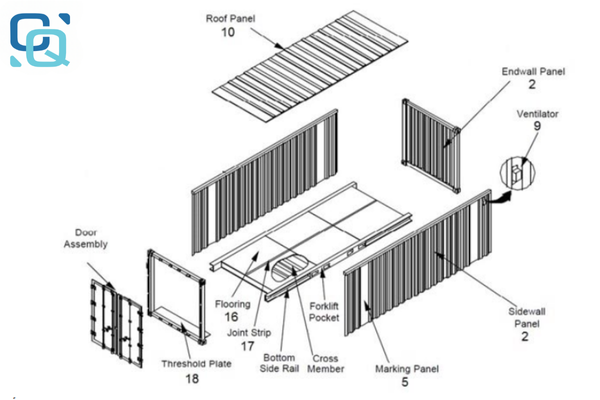
Container, also known as cont, is a type of standard sized cargo container, specially designed for safe transportation via different modes such as sea, road, rail and even air. Containers are made from sturdy steel or aluminum, has high bearing capacity, Resistant to harsh weather and easy to load and unload with cranes or specialized equipment.
The history of containers dates back to the 1950s, when American businessman Malcolm McLean invented the standardized container, revolutionize the transportation industry by reducing loading and unloading time and increasing logistics efficiency. Nowadays, Containers are symbols of globalization, helps goods move quickly from manufacturing plants to consumers around the world.
Containers are not just that “shipping box” simply but also a standard unit of measurement in transportation. One 20 foot container (20FT) equivalent to 1 TEU (Twenty-foot Equivalent Unit), while 40 feet container (40ft) equivalent to 2 TEUs. Using containers helps reduce costs, Increase shipping speed and ensure goods safety.
In the context of booming e-commerce and complex global supply chains, Containers play an important role in connecting economies. In Vietnam, with strategic geographical location, Container is a tool to support import and export, especially with items such as textiles and garments, electronics and agricultural products.
So we have answered the question of what a container is

Common Types of Containers
There are many types of containers designed to suit different cargo characteristics. Below is a detailed classification of the main container types, based on size, functions and applications.
1. Sort By Size
Containers are manufactured with standard sizes according to ISO regulations (International Organization for Standardization), Ensures global compatibility.
-
Container 10 feet (10FT): Compact size with 3m length, 2.44m wide, 2.59m high. Capacity is about 15m³, tonnage 10-12 tons. Suitable for small batches, Domestic shipping or market testing. Less common but cost effective for light goods.
-
Container 20 feet (20FT): Basic standard size, long 6.06m, 2.44m wide, 2.59m high. Capacity 33m³, tonnage 20-25 tons. This is the most common type of container, equivalent to 1 TEU, Ideal for medium goods such as clothing, packaged food.
-
Container 40 feet (40ft): Bigger, 12.19m long, 2.44m wide, 2.59m high. Capacity 67m³, tonnage 25-30 tons. Equivalent to 2 TEUs, suitable for large goods such as furniture, machines. This is the type most used in international shipping.
-
Container 45 feet (45FT): 13.72m long, capacity 76m³, Same payload 40FT. Used for modern transport routes, where space optimization is needed.
2. Classification According to Function
How many types of containers are there and what are the functions of containers? ?
In addition to size, Containers are also classified by design to suit specific types of goods.
-
Dry containers (Dry Container): The most basic type, completely sealed, Used for dry goods such as consumer goods, textile, electronics. There is a standard version (GP – General Purpose) and high cube (HC – taller than 30cm, larger capacity).
-
Refrigerated containers (Reefer Container): There is an integrated cooling system, Temperature control from -30°C to +30°C. Suitable for fresh food, pharmaceutical, fruit. The cost is higher but the quality of goods is guaranteed.
-
Container with open roof (Open Top Container): Open the roof, cover with tarpaulin, Used for bulky goods such as machinery, wood, Need to load and unload from top to bottom with crane.
-
Side opening container (Flat Rack Container): There are no side walls, only floor and fixed terminals. Ideal for super-long and heavy goods such as industrial equipment, truck.
-
Container bồn (Tank Container): Cylinder, Used for liquids such as chemicals, oil, liquid food. There is insulation and a safety valve.
-
Folding containers (Foldable Container): Can be folded to save space when empty, suitable for multimodal transport.
3. Other Special Types of Containers
What are the special types of containers? ?
-
Container Half Height: Higher and lower, Used for heavy goods such as mineral ores.
-
Container Ventilated: There are ventilation holes, Used for agricultural products that require ventilation.
-
Container Platform: Floor only, no walls, Used for oversized goods.
Total, There are more than 10 main types of containers, but 20FT and 40FT dry account for the largest proportion of global transport.
Application of Containers in Transport
What is the application of Containers? ? Containers are not only used for sea transport but are also flexible in other methods:
-
Sea transportation: Accounts for 90% of global trade, Containers help in quick loading and unloading at the port, reduce waiting time.
-
Road transport: Containers are transported by truck, Easy transition from port to warehouse.
-
Railway transport: Use trains to transport containers, Save costs for long distances.
-
Air transport: Smaller containers (ULD – Unit Load Device) used for airplanes.
Container application helps reduce goods damage by 80%, Increase shipping speed and lower logistics costs.
Benefits of Using Containers
What are the benefits of using Containers? ?
-
Standardize: Uniform size makes stacking easy, multimodal transportation.
-
Safe: Rugged design protects goods from the weather, theft.
-
Save costs: Reduce loading and unloading labor, space optimization.
-
Easy tracking: GPS can be attached, RFID for real-time tracking.
-
Environmentally friendly: Reuse, Reduce packaging waste.
In Vietnam, Containers support coffee export, rice, phone, with customs clearance through ports like Cat Lai reaching up to millions of TEU/year.
Challenges and Trends in Container Development
What are the challenges and development trends of containers? ?
Challenge: Port congestion, missing empty containers, fuel costs increase. Trend: Smart containers with IoT, Green containers use renewable energy, and container automation.
Future, containers will integrate AI to predict maintenance and optimize routes.
Conclude
Containers are the foundation of modern transportation, with a variety of types to meet all needs. Understanding containers helps businesses optimize logistics. Follow Cuong Quoc Logistics for more updates!
Cuong Quoc Freight Forwarding Company Limited
Office: 7th floor, Parami Building, 140 Bach Dang, Tan Son Hoa Ward, Ho Chi Minh City
Hotline: 0972 66 71 66
Email: info@cql.com.vn
Website: https://cql.com.vn/

See more at