Article Content
- 1 1. Introduction — Choosing the wrong C/O: immediately lose tax incentives
- 2 2. What is C/O?? Role in import and export
- 3 3. Distinguish common types of C/O: AND, VK, D, E, AI
- 4 4. When should I choose which form?? (quick decision)
- 5 5. Conditions for C/O to be valid (very often wrong)
- 6 6. 3 big risks when using C/O incorrectly
- 7 7. Conclude & Consulting from CQL
1. Introduction — Choosing the wrong C/O: immediately lose tax incentives
Same shipment, same supplier, same HS code.
Businesses choose correctly C/O will receive tax 0%. Opposite, If you choose the wrong form, you will immediately be subject to tax 5–20%, That means losing tens to hundreds of millions more dong on just one shipment.
Reality, Many Vietnamese SMEs are still facing this situation. Businesses don't know there are many types of C/O forms differences or confusion between FTA agreements. As a result, costs skyrocketed, profits are eroded.
C/O is not just a document — which is “the key to reducing import costs”. Choosing the right form helps businesses make the most of tax incentives. Choose wrong, The incentive is lost right from the first declaration.
In CQL, We once supported a business importing electronic components. Just because you chose the wrong form, The business immediately lost 96 million VND in tax on a shipment of 800 million VND. After converting to the appropriate form, All shipments enjoy 0% tax.
2. What is C/O?? Role in import and export
C/O (Certificate of Origin) hay Certificate of origin of goods is a document issued by a competent authority of the exporting country, Prove the origin of the shipment.
Theo Decree 31/2018/ND-CP (Article 3), C/O is a legal document certifying that goods originate from a country, specific group of countries or territories.
The most important role of C/O:
- Determine the source to apply tariffs.
- Allow enjoyment FTA preferential tax (can be reduced to 0%.).
- Is a mandatory document when clearing certain goods.
Many businesses still think “yes C/O is a tax reduction". Reality It's not that simple. Must be C/O in correct form, accordance with the agreement and fully meet the rules of origin.
Businesses who want to understand the basic concepts before delving into choosing a form can refer to the article What is C/O in Import and Export? Comprehensive Guide 2026.
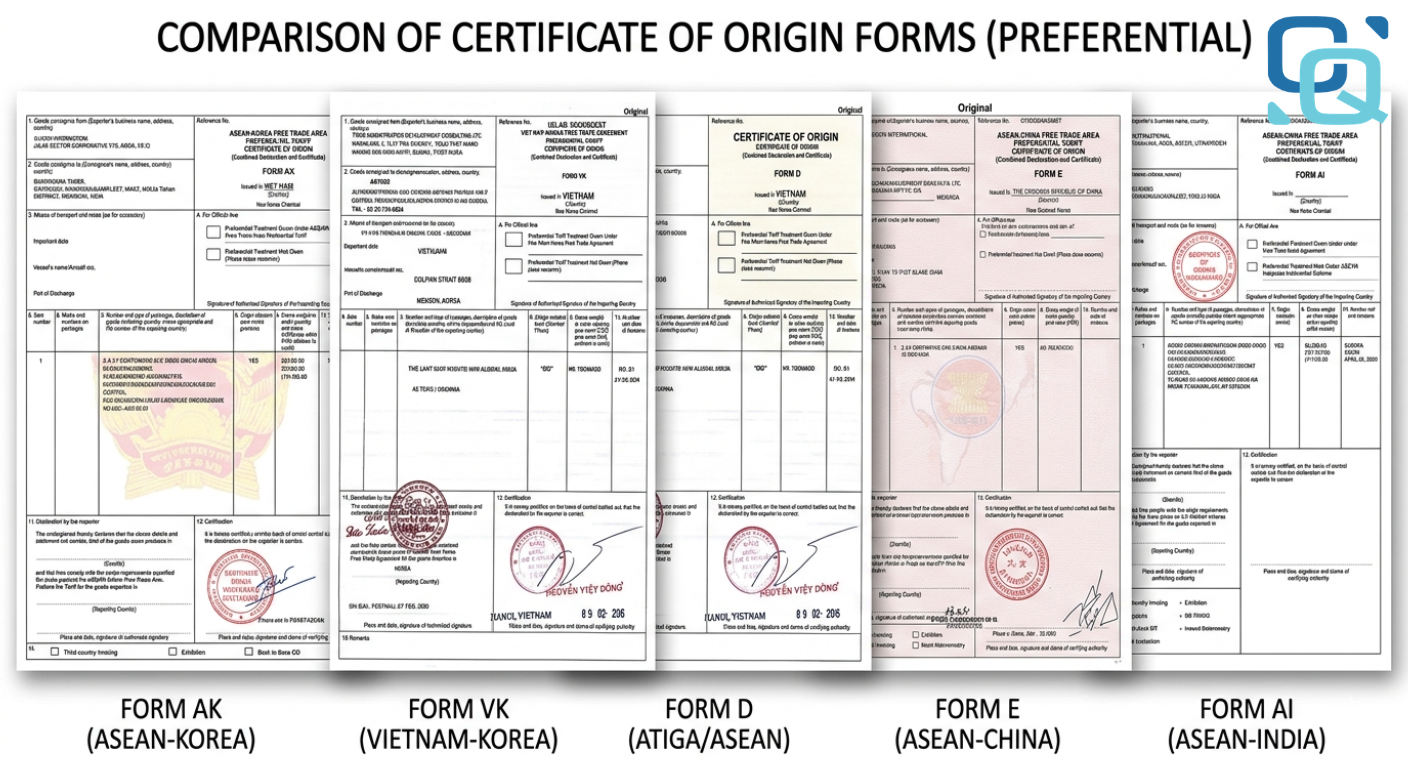
3. Distinguish common types of C/O: AND, VK, D, E, AI
Below is a detailed comparison table types of C/O forms most popular today:
| Form | Agreement | Main application | Typical incentives | Important note |
|---|---|---|---|---|
| AND | AKFTA (ASEAN – Korea) | Goods imported from Korea | 0–5% | Popular but incentives are not maximum |
| VK | VKFTA (Vietnam – Korea) | Goods imported from Korea | 0% in many product groups | Offers deeper than AK |
| D | AT LEAST (ASEAN) | Intra-ASEAN goods | 0% completely | Used exclusively for intra-bloc trade |
| E | ACFTA (ASEAN – China) | Goods imported from China | 0–5% | The most popular form with Chinese sources |
| AI | AIFTA (ASEAN – India) | Goods imported from India | 0–10% | Rules of origin are often strict |
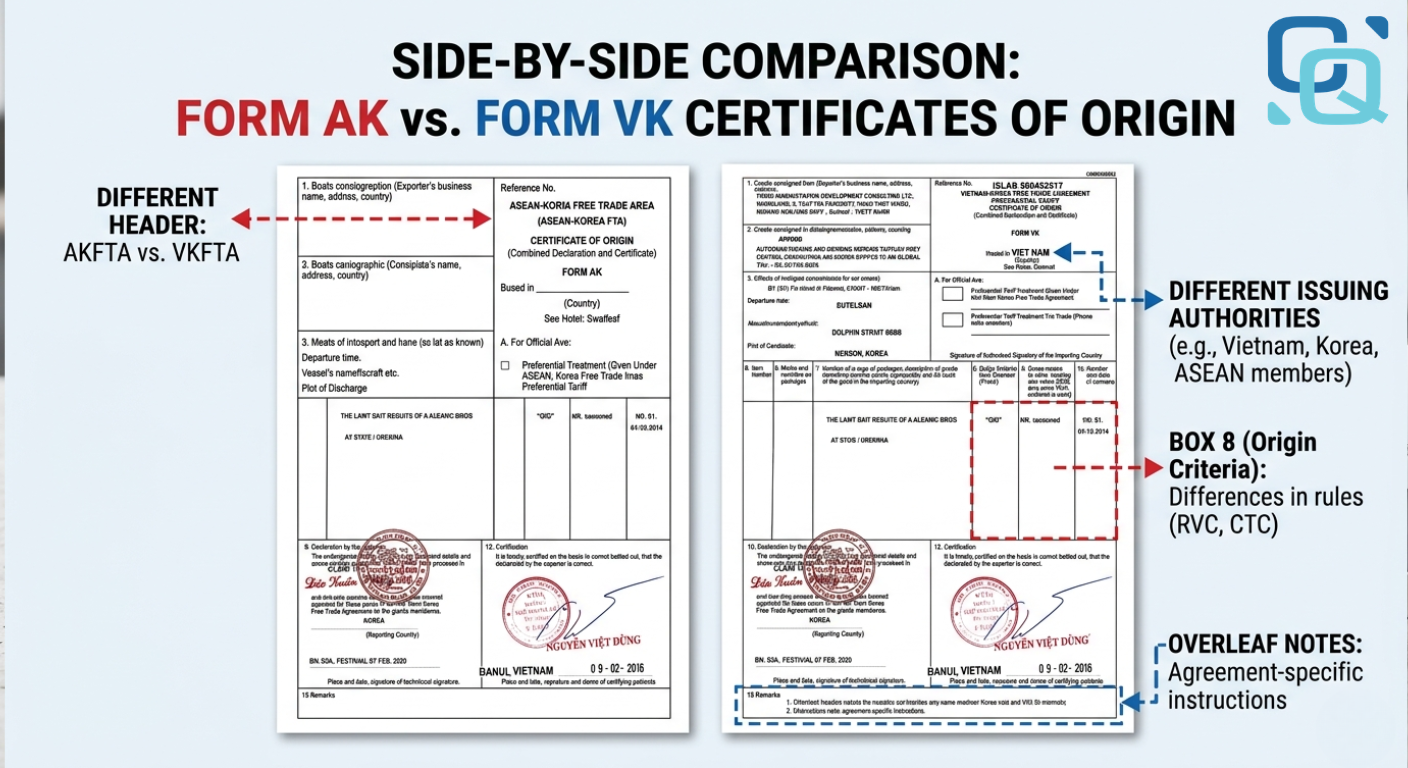
Specific comparison table of AK vs VK (Real-life example 2026):
| HS code | Description of goods | AK tax | VK tax | Difference |
|---|---|---|---|---|
| 8471.30 | Laptop | 5% | 0% | 5% |
| 8544.42 | Electronic cables | 3% | 0% | 3% |
| 8504.40 | Power supply unit | 0% | 0% | 0% |
Insight from CQL: Same batch of electronic components from Korea, Two businesses choose two different forms. Use one side AND subject to 5% tax, across (Okay CQL support) switch to VK enjoy 0% tax. The difference is only one form but saves tens of millions per lot.
4. When should I choose which form?? (quick decision)
Step-by-step process for applying for C/O (CQL applies internally):
- Determine the exporting country
- Look up the FTA agreement in effect
- Check preferential tax rates according to the current tax schedule
- Confirm the supplier is capable of providing the correct form
- Require supplier to request C/O and check before shipping
Case 1: Imported from Korea → Priority VK if qualified (deeper incentives than AK).
Case 2: Imported from China → For use only Form E.
Case 3: Enter ASEAN → For use only Form D.
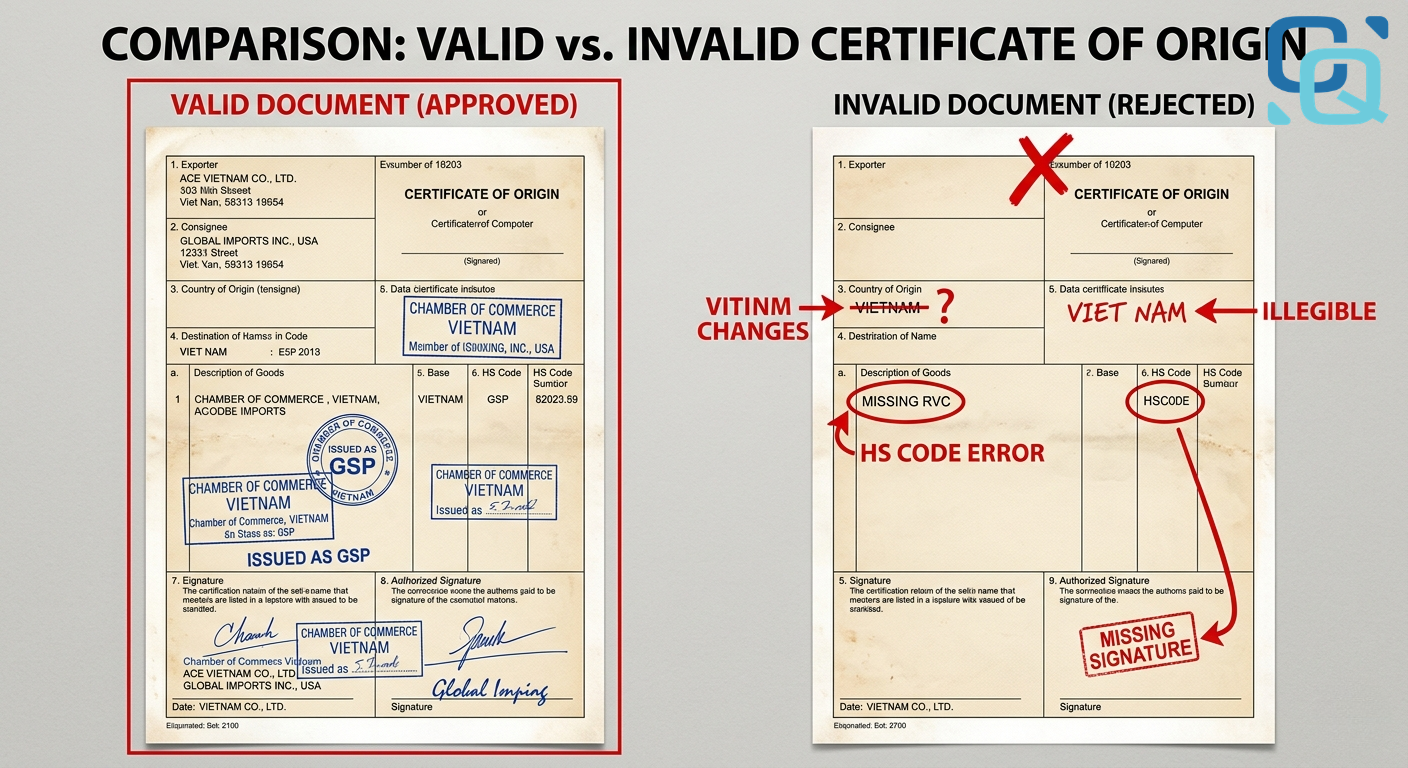
5. Conditions for C/O to be valid (very often wrong)
C/O To be valid, all 3 conditions must be met:
- Correct form and correct agreement.
- Hand signed + wet stamp.
- Meets the correct origin criteria (WO, CTC, RVC…).
The most common errors: wrong product name, sai HS code, C/O issued after the shipment date.
Sample letter requesting re-issuance of C/O (CQL is often used): SOCIALIST REPUBLIC OF VIETNAM Independence – Freedom – Happiness
APPLICATION FOR RE-ISSUANCE OF CERTIFICATE OF ORIGIN Dear: ………………… (VCCI / Ministry of Industry and Trade) We would like to reissue C/O Form … number … for reasons: Incorrect description of goods / wrong HS code / issued late. Shipment details: Invoice number … date … …
Actual case: Businesses import components, C/O VK misspelled a word in the description → customs refused. CQL Assist in preparing documents, Additional documents and re-issue within 3 working days. Result: Shipments enjoy 0% tax instead of 5%.
(Your business can read more C/O rejected - Cause & how to handle to avoid similar situations).
6. 3 big risks when using C/O incorrectly
Risks 1: Complete loss of tax incentives → skyrocketing costs.
Risk 2: Tax arrears + late payment penalty (5 year post-audit).
Risk 3: Slow customs clearance, incur storage and demurrage fees.
CQL once supported a business that had to pay 250 million VND in arrears for using it Form AK instead of VK. After making a complaint and adding complete documents, The arrears decreased to 87 million VND.
7. Conclude & Consulting from CQL
Choose the right one types of C/O forms It's not difficult if businesses understand the difference and have a clear checklist. That is the most legal and effective way to optimize taxes today.
CQL specializes in business support: Advise on choosing the correct form for each shipment, Check the documents from the supplier in advance, Prepare explanation letters and quickly handle cases C/O rejected.
Your business is importing and needs to check C/O? Contact now CQL for practical support.
Cuong Quoc Freight Forwarding Company Limited
Office: 7th floor, Parami Building, 140 Bach Dang, Tan Son Hoa Ward, Ho Chi Minh City
Hotline: 0972 66 71 66
Email: info@cql.com.vn
Website: https://cql.com.vn/
(The article is based on practical experience supporting thousands of shipments in 2026, comply with Decree 31/2018/ND-CP, Circular 05/2018/TT-BCT and FTAs: VKFTA, AKFTA, AT LEAST, ACFTA, AIFTA).

See more at