Article Content
- 0.1 Introducing Vietnam's import and export industry in 2025
- 0.2 Why is the import-export industry attractive to newcomers and young businesses?
- 0.3 Objective of the article: Share practical experiences for newcomers
- 1 Correct understanding of "import and export" and the role of the industry
- 2 Basic import and export process structure
- 3 Basic knowledge that newbies need to master
- 4 Practical experience for beginners
- 5 Common mistakes of newbies
- 6 Suggested roadmap for learning and developing import-export career
- 7 Free tools and resources in 2025
- 7.1 Look up HS code, tax rates via website
- 7.2 Electronic customs procedure information portal VNACCS/VCIS
- 7.3 Forum, Facebook/XNK group association, Vietnam logistics
- 7.4 Support system from the Ministry of Industry and Trade, VCCI
- 7.5 Consulting on the full import process
- 7.6 Support customs declaration, booking, document
- 7.7 Logistics cost saving solution for newcomers
- 8 Conclude
Introducing Vietnam's import and export industry in 2025
In the context of the global market increasingly integrating and developing, Vietnam's **import-export** industry is expected to continue to play a central role in the national economy by 2025. Big opportunities come from expanding free trade agreements, Promote the export of goods to major markets such as the US, EU, China, and ASEAN. Simultaneously, This industry also faces many challenges, like exchange rate fluctuations, legal risks, or fierce competition from other countries.
However, This is still an attractive field for new person and young businesses because:
- You can start on a small scale, Optimize initial costs
- Opportunity to quickly learn about international markets and processes
- Promote negotiation skills, risk management, and develop a global business network
- Potential for scale expansion and product diversification in the long term

Why is the import-export industry attractive to newcomers and young businesses?
The **import-export** industry is much more accessible than other areas of business, Especially suitable for **beginners**. The main reasons include: – The initial investment cost is not too large, can start on a small scale, according to each shipment.
Objective of the article: Share practical experiences for newcomers
The goal of this article is: – Provides basic knowledge and necessary preparation steps to start **importing and exporting** in a methodical way.
Go there, hope that the new person at the start of my journey in the industry import and export There will be precise steps, more confident and effective, contributing to improving the competitiveness of ourselves and businesses in an increasingly demanding international environment.
Correct understanding of "import and export" and the role of the industry
In the context of increasingly profound globalization, branch import and export plays a central role in the international economic ecosystem. For beginners, Correct understanding of this concept not only helps to clearly define career direction but also contributes to improving the ability to succeed in the actual working process..
Basic concepts of exporting, import
First, export is the activity of selling goods, services from one's own country to the international market for consumption or investment purposes. Opposite, import is the process of purchasing goods, services from other countries for domestic consumption or production use. Understanding these two concepts helps newcomers grasp the process and steps involved in international trade activities, At the same time, clearly identify its role in the global supply chain.
These activities include many steps, from searching for sources of goods, contract negotiation, transport, customs declaration to receipt and final distribution. Mastering the basic concepts will help newbies avoid making common mistakes such as misunderstanding benefits, obligations or penalties for incorrectly declaring product codes or missing documents.
Industry's role in the global supply chain
Branch import and export holds a key position in the global supply chain, plays the role of connecting businesses, manufacturer, distributor, final customers around the world. Specifically, this industry:
- Support the development of international trade, Helps businesses expand markets and increase sales.
- Contribute to promoting the national economy, create foreign currency and promote the development of supporting industries.
- Transfer of technology and knowledge, contributing to improving the competitiveness of domestic enterprises.
- Support supply diversification, Reduce dependence on the domestic market, helps stabilize prices and ensure the supply of essential goods.
Not only that, import and export also plays a role as “bridge” in optimizing global resources, Combining the competitive advantages of each country to form an increasingly effective global value chain. So, This industry is not simply a commercial activity, but also a bridge to promote the sustainable development of economies in the new era.
Business models participating in import and export
Branch import and export Diverse with many operating models suitable for beginners or small businesses, include:
- Manufacturing enterprise: export its own products to the international market, Usually businesses that have brands or large production scale.
- Commercial enterprise: trading activities, intermediate, Import goods from manufacturers and then distribute them to the domestic market or export them according to signed contracts.
- Logistics and transportation services: companies providing transportation services, storage, customs declaration, Help other businesses carry out import and export activities conveniently and effectively.
- Agents, brokers: intermediaries connect the parties, Helps find suitable customers or product sources, and negotiate contract terms.
Each model has its own characteristics, suitable for the scale and strategy of each business. Beginners need to clearly identify a suitable model from which to build knowledge, Appropriate skills and development strategies, contribute to promoting the industry import and export of themselves and contribute to the overall development of the national economy.
See more: Sea shipping service
Basic import and export process structure
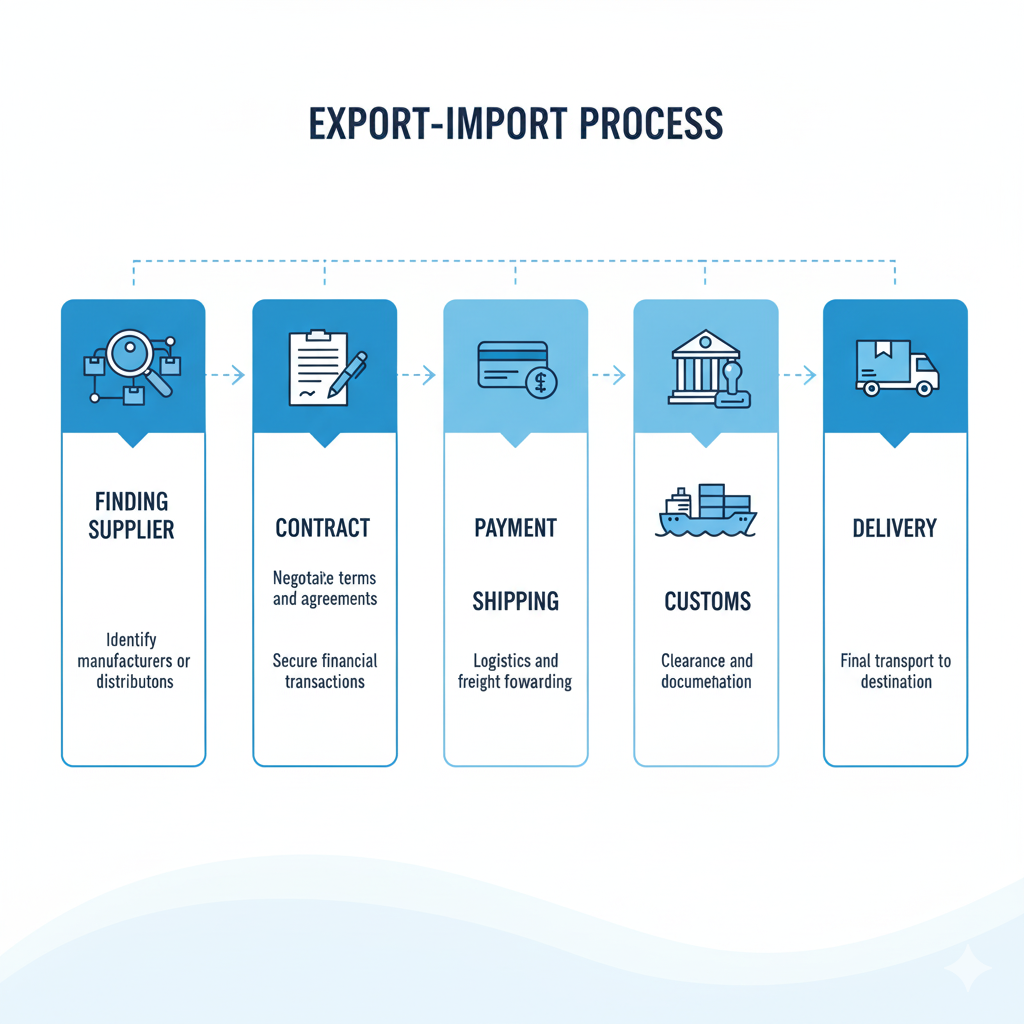
In activity import and export, understanding process structure is a necessary factor to ensure the implementation steps go smoothly, comply with the law and optimize costs. For beginners, Mastering this process helps them easily control every step, from sourcing goods to final delivery of goods. Below is a detailed description of the main steps in Basic import and export process structure:
Search for international sources and customers
The first step in import and export process is to identify suitable product sources and potential customers in the international market. Newcomers need to carefully study the markets, evaluate product quality, Competitive prices and finding reliable partners through forums, industry groups or personal relationships, professional. This helps minimize risks, Avoid importing unsuitable or unmarketable goods.
Negotiate foreign trade contracts, International payment
After identifying partners, The next step is negotiation and signing foreign trade contracts. During this process, important terms such as price, quantity, Delivery conditions (theo Incoterms), payment method (such as T/T, L/C) and risk terms will be carefully negotiated. Newcomers need to clearly understand the terms of the contract to avoid financial losses or legal disputes later.
Transport, Declare customs and complete procedures
When the contract has been signed, Goods will be included in the shipping process. Newcomers need to coordinate with transport units to make bookings, Track shipping and prepare necessary documents such as bills of lading (Bill of Lading), commercial invoice, packing list. Simultaneously, Goods must be declared to customs according to regulations, pay taxes (if any) and complete customs procedures so that goods are legally allowed to be imported/exported. This process requires employees to clearly understand the provisions of customs law, documents and tax rates.
Illustration of a simple import and export process diagram
For easy visualization, diagrams can be formed import and export process as follows:
- Search for product sources/customers → 2. Contract negotiation & payment → 3. Make a transportation booking → 4. Prepare documents & customs declaration → 5. Transporting goods → 6. Customs clearance and receipt of goods → 7. Delivery and post-inspection
This diagram makes it easy for novices to follow the main steps in import and export process, Make sure not to miss any necessary steps. Simultaneously, This clear visualization also helps them control the stages well, Minimize errors and optimize time, expense.
So, Basic import and export process structure includes sequential and logical steps: From identifying product sources and customers, contract negotiation, transport, customs declaration, until the goods are successfully delivered. Understanding and mastering each of these steps is an important foundation for beginners to progress further in the industry import and export professionally and confidently.
Basic knowledge that newbies need to master
In the journey starting with the industry import and export, Equipping yourself with basic knowledge is extremely important to ensure the working process goes smoothly and effectively.. Special, for beginners, understanding the concepts, Related processes and policies will help limit risks, Optimize costs and improve competitiveness in the international market. Below are the basic knowledge that newbies need to master to confidently step into the import-export industry.
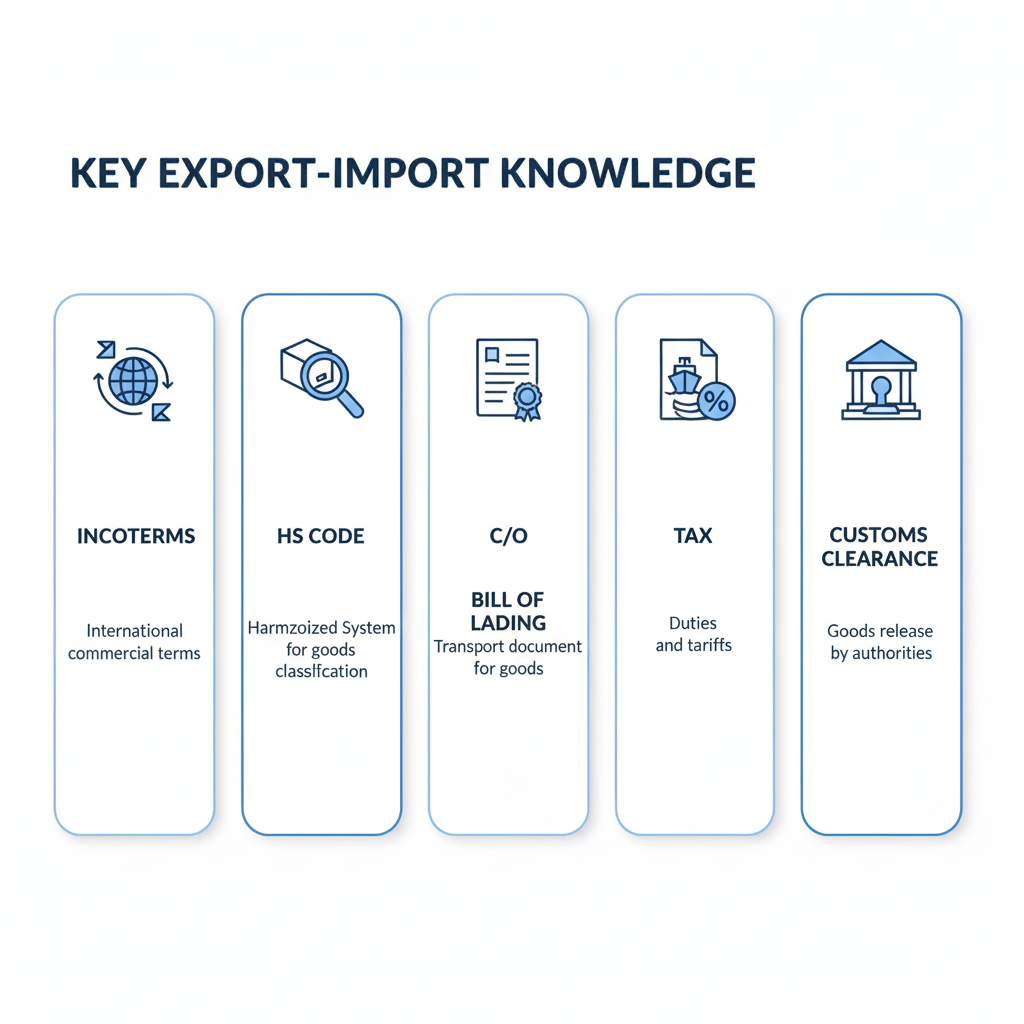
Incoterms 2020 and HS Code types
- Incoterms 2020 is a set of international rules that clearly stipulate obligations, Responsibilities of the seller and buyer during the international transportation of goods. Common terms like FOB, CIF, EXW, DDP helps clearly define shipping responsibilities, insurance, risk, costs of each party. Correct understanding of Incoterms helps newbies avoid making mistakes in contract negotiations, At the same time, well control arising fees.
- HS Code (Harmonized System Code) is the international commodity code used for classification, Accurately determine the type of import and export goods. Declaring the correct HS code helps determine the tax rate, preferential policy, Ensuring goods clear customs quickly, Avoid penalties or delays due to false declarations.
Certificate of origin, bill, packing list, bill of lading
- Certificate of origin (C/O) is a document certifying the origin of goods, Helps enjoy tax incentives under FTA policies or free trade agreements. Newcomers need to know how to apply for and check C/O properly to avoid losing benefits.
- Commercial invoice (Invoice) is a payment document, represents the value of the goods, transaction terms. Accurate invoicing is a decisive factor in the payment and customs clearance process.
- Packing list is the packing list, Detailed description of the goods in the container, help check, Compare goods upon receipt and carry out import and export procedures.
- Bill of Lading (B/L) is the bill of lading, freight documents, Demonstrate ownership of goods during transportation and customs clearance. Newcomers need to clearly understand how to read and check the contents of the B/L to avoid risks during transportation.
Import tax, VAT, FTA preferential policies
- Import tax is a tax levied on goods when imported into Vietnam, depending on the type of item and HS code.
- Value added tax (VAT) Applies to imported goods, usually 10%, unless there is a preferential policy.
- FTA policy (Free trade agreement) Helps businesses take advantage of tax incentives, reduce import costs, promote exports. Newcomers need to clearly understand the conditions, procedures to exploit these incentives legally and effectively.
Mastering this fundamental knowledge will create a solid foundation for newcomers to enter the industry import and export confidently, professional. Not only helps handle daily tasks, This knowledge also helps limit legal and financial risks, opens up opportunities for sustainable development in this competitive field.
Practical experience for beginners
While working in the industry import and export, especially for beginners, Accumulating practical experience is the decisive factor to help you avoid common mistakes and improve work efficiency.. Below are useful shares based on reality, Helps you have solid steps on your journey of development in this industry.
Understand the product well & market to avoid risks
One of the most important experiences for new person is mastering knowledge about the product and target market. Specifically:
- Understand the technical characteristics of the product: This helps you determine the correct HS code, Accurately identify necessary documents, thereby minimizing the risk of being fined or delayed in the customs clearance process.
- Research the consumer market: Hiểu rõ nhu cầu, trend, Import market regulations help you avoid having unsuitable inventory of goods or being fined for violating product regulations..
- Phân tích cạnh tranh: Refer to competitors in the same industry to determine price, appropriate sales strategy, thereby optimizing profits and maintaining business competitiveness.
This helps newcomers avoid importing goods that are not regulated, giảm thiểu rủi ro tài chính và nâng cao năng lực cạnh tranh.
Choose a reputable logistics partner
Chọn đúng đối tác logistics phù hợp sẽ giúp quá trình import and export went smoothly, Minimize risks and control costs. Some experiences include:
- Đánh giá năng lực và uy tín của các công ty logistics: Tham khảo phản hồi từ các khách hàng cũ, Review operating license, related certificates.
- Thỏa thuận rõ ràng về dịch vụ và chi phí: Make sure to sign a clear contract regarding the scope of services, time, service fee, Compensation provisions when incidents occur.
- Choose a partner with a transparent shipping tracking system: Helps you easily control the process, Update goods status anytime, anywhere.
Choosing the right logistics partner will help minimize the risk of loss, lost goods as well as good control of shipping costs.
Check documents before goods arrive
Other important experience for new person Always carefully check the relevant documents before the goods arrive at the warehouse or receiving point. Documents that need attention include::
- Commercial invoice, packing list, bill of lading: Make sure the information is accurate, according to the contract and without omissions.
- Certificate of origin (C/O): Check whether the goods comply with origin regulations to enjoy tax incentives.
- Documents related to quality inspection, quarantine (if any): Ensure goods meet the requirements of import markets.
Thoroughly checking documents helps minimize the possibility of goods being retained, penalties or ineligibility for tax incentives.
Take advantage of online tools and industry communities
Market import and export always fluctuating and requiring constant updates of new information. For new person, Leveraging online tools and industry communities is an effective approach to improving knowledge and expanding networks:
- Websites to look up HS codes, tax rate: Helps accurately determine product codes and latest tax rates.
- Electronic customs information portal VNACCS/VCIS: Support to look up procedures, Fast customs declaration process.
- Forum, Facebook/XNK group, Vietnam logistics: A place to share experiences, Answer questions and update new trends.
- Support system from the Ministry of Industry and Trade, VCCI: Provide policies, instruct, Free documents, Helps newcomers easily access and grasp knowledge.
This doesn't just save you time, but also minimize risks due to lack of information, At the same time, improve skills in handling real-life situations during the work process import and export.
Overall, These practical experiences will help beginners tích lũy kiến thức, Effectively handle arising situations and improve competitiveness in the increasingly vibrant and demanding professional import-export industry.
Common mistakes of newbies
At the beginning of your journey in the industry import and export, especially for newbies, Being aware of common mistakes is extremely important to avoid risks and save time, expense. Below are some of the most common errors that the new person easy to get, along with analysis and advice to help limit these mistakes.
Not understanding Incoterms leads to additional fees
One of the biggest mistakes of new person in the industry import and export is the lack of knowledge about Incoterms. These are international commercial terms that clearly stipulate the responsibilities and obligations of the parties during the delivery process. If you do not understand these regulations, new person It is easy to misunderstand or overlook obligations such as transportation, insurance, or costs arising outside the contract. This leads to unexpected fees being incurred, gây thiệt hại về tài chính và ảnh hưởng đến lợi nhuận của lô hàng. To avoid this, Newcomers need to study carefully Incoterms 2020 và áp dụng đúng theo từng trường hợp cụ thể.
Wrong declaration of HS code, fined or delayed customs clearance
Errors in declaration HS Code là một trong những nguyên nhân phổ biến khiến hàng hóa bị chậm trễ hoặc bị phạt từ cơ quan hải quan. Code HS Code clearly specify the type of goods, giúp xác định thuế suất và chính sách thông quan phù hợp. If you declare the wrong code, Authorities may request a re-examination, or even fined or required to re-export the goods. Special, Declaring the wrong code also affects tax benefits, allowing airlines to enjoy preferential tariffs under FTA policies. Newcomers need to take the time to learn thoroughly HS Code and check for accuracy before submitting the declaration.
Do not check documents, Airlines enjoy tax incentives
Documents are the deciding factor for your goods new person Whether to enjoy tax incentives or not. Documents such as Certificate of origin (C/O), bill, packing list, Bill of lading must be accurate and complete. If you skip this check step or do not understand the process clearly, new person may unintentionally miss out on tax benefits, resulting in higher than expected costs. Even, Goods may be refused customs clearance or detained at the border gate. So, Carefully checking documents before goods arrive is an indispensable step to ensure your rights.
Forgot to control container deadlines, fees easily arise
During transportation, Forgetting to track container deadlines is free (free time) is a common error of new person. When this time limit is exceeded, Goods will be charged container storage or storage fees, causing unexpected cost increases. Special, if you do not closely control the deadlines, Newcomers easily fall into a situation of large additional fees, affects the profits and competitiveness of businesses. That's why, planning, Monitoring the free time expiration date in the contract and promptly contacting the carrier is essential to limit financial risk..
These mistakes, although popular, But it can be completely avoided if the newbie prepares with proper knowledge and pays attention to carefully checking the processes, document. Equipping yourself with the right knowledge from the start will help build a solid foundation for a career in the industry import and export, At the same time, it helps reduce risks, Optimize profits and expand development opportunities in a competitive international market.
Suggested roadmap for learning and developing import-export career
In industry import and export growing and bringing many opportunities, especially for beginners, Building a clear learning and development path is a decisive factor for success. Below are specific stages to help newcomers gradually become experts in this field.
Stage 1: Master the process & basic documents
Đây là bước nền tảng để xây dựng kiến thức vững chắc về ngành xuất nhập khẩu. Newcomers need to clearly understand the steps in the process, from searching for sources of goods, khách hàng quốc tế, to basic documents such as invoices, packing list, bill of lading, certificate of origin (C/O), and terms related to Incoterms. This phase also includes getting acquainted with customs procedures, cách khai báo và những quy định pháp luật liên quan để tránh rủi ro pháp lý sau này. Việc nắm vững các kiến thức này giúp người mới xác định rõ các bước cần thiết trong quy trình, từ đó xây dựng nền tảng vững chắc cho các bước tiếp theo.
Stage 2: Practice with 1–2 small actual batches
Sau khi đã nắm vững kiến thức lý thuyết, bước tiếp theo là áp dụng thực tế qua các lô hàng nhỏ. Newcomers can start by cooperating with businesses or trusted partners to practice the import and export process on a small scale.. This stage helps practice document checking skills, Make a transportation booking, track goods progress, and handle arising situations such as document errors or delays. Hands-on practice will help newcomers understand the practical aspects of the industry, thereby improving the ability to handle situations and being more confident when entering larger transactions.
Stage 3: Improve negotiation skills, Find global customers
Once you have a solid foundation and gradually accumulate experience, Newcomers need to expand their international contract negotiation skills, Optimize shipping costs, and find customers, global partner. This stage requires learners to clearly understand the terms of the contract, tax policies, FTA incentives, as well as how to build sustainable relationships with partners. Besides, improving foreign language skills, Participate in seminars, Industry group associations to expand connection networks are essential. Đây là giai đoạn giúp người mới trở thành những chuyên gia có khả năng xử lý các thương vụ phức tạp và mở rộng phạm vi hoạt động trong ngành.
Stage 4: Open a company or become a logistics agent
Once you have accumulated enough knowledge and skills, người mới hoàn toàn có thể hướng tới việc thành lập công ty thương mại hoặc trở thành đại lý logistics độc lập. This stage requires the ability to comprehensively manage business activities, Understand clearly the legal regulations on businesses, build a long-term development strategy, while maintaining customer and partner relationships. Besides, việc tự xây dựng thương hiệu và mở rộng quy mô hoạt động sẽ giúp người mới trở thành những doanh nhân trong ngành xuất nhập khẩu và logistics.
Overall, This roadmap helps beginners start with basic knowledge, through small practice, Improve negotiation skills and expand your network, Finally, build a sustainable career and long-term development in the import-export industry. Following this roadmap will help minimize risks, Optimize your chances of success, At the same time, create a solid foundation for a career in this potential industry.
Free tools and resources in 2025
In the process of making import and export give new person, Access to free support tools is key to minimizing risk, Save costs and improve work efficiency. 2025, Many online platforms and official systems have developed to accompany businesses, especially those just starting out in this industry.
Look up HS code, tax rates via website
One of the most useful free tools for new person in import and export are HS code lookup websites (Harmonized System) and tax rates. These platforms provide up-to-date data, Accurate product codes in accordance with international regulations, Helps businesses determine the exact type of tax they need to pay when importing or exporting goods. These websites are often updated according to the latest regulations of Vietnam Customs and international organizations, Support businesses to quickly determine HS codes and calculate appropriate taxes, Minimize errors during the declaration process.
Electronic customs procedure information portal VNACCS/VCIS
System VNACCS/VCIS is the official electronic information portal of Vietnam Customs, provide support services new person in customs declaration, Monitor customs clearance progress and handle procedures related to import and export. Instead of having to go directly to the agencies, businesses can operate, Apply, Check the status of goods through this system conveniently, quick. Proficient use of this system helps reduce time and costs, At the same time, improve accuracy during the procedure.
Forum, Facebook/XNK group association, Vietnam logistics
Online communities such as forums, Facebook group about import and export, Logistics and international trade are valuable sources of support for new person. Here, businesses, Individuals can share experiences, Ask and answer practical problems, Update the latest news about policies, procedure, support tools. These groups also help expand your network of relationships, Find partners or get advice from people with many years of experience in the industry, thereby helping newcomers easily overcome initial difficulties.
Support system from the Ministry of Industry and Trade, VCCI
In 2025, government agencies such as the Ministry of Industry and Trade and the Vietnam Chamber of Commerce and Industry (VCCI) has expanded small business support programs and new person join import and export. These systems provide documentation, Free online courses, consulting programs, Online seminar to help businesses understand regulations, Latest policies as well as updated preferential policies, tariff support. Besides, Registering to participate in these programs also helps businesses access resources, Support policies from the state easily and effectively.
Overall, These 2025 free tools and resources go a long way in helping new person do import and export quickly grasp knowledge, effective practice, Minimize risks and keep up with industry trends. Making the most of these platforms not only helps save costs but also enhances the competitiveness of businesses in an increasingly vibrant international market..
[h2] Newcomer support service of CUONG QUOC Logistics
In industry import and export, especially for beginners, Mastering the process and handling complex procedures can cause many difficulties. Understand this, CUONG QUOC Logistics has built professional support services to accompany new businesses and individuals to easily access the industry., efficient and time-saving, expense. Below are the main solutions that CUONG QUOC Logistics provides to support new person on the journey to conquer the international market.
Consulting on the full import process
One of the strengths of CUONG QUOC Logistics is its import process consulting service package, help new person No longer confused by basic and complex steps such as:
- Understand clearly the steps from sourcing goods, contract negotiation, to shipping and customs declaration.
- Consulting on types of documents that need to be prepared such as invoices, packing list, bill of lading.
- Instructions on how to handle legal procedures, Necessary licenses to ensure quick customs clearance of goods, according to regulations.
This service helps customers master the process from A to Z, Minimize the risk of errors and avoid unnecessary fees.
Support customs declaration, booking, document
CUONG QUOC Logistics provides comprehensive support services in important stages such as:
- Customs declaration: Instructions and implementation of accurate declaration, on time to avoid delays or fines.
- Booking transportation: Container reservations, ship, suitable flight, Helps optimize shipping time and costs.
- Prepare documents: Ensure documents such as certificate of origin, commercial invoice, packing list, bill of lading is correct, fully as required by customs authorities and international partners.
CUONG QUOC Logistics staff are always ready to assist customers in processing documents, procedure professionally, help new person More peace of mind when participating in import and export activities.
Logistics cost saving solution for newcomers
Cost saving is an important factor for the new person no interruptions in the process of starting international business. CUONG QUOC Logistics provides solutions such as:
- Consulting on choosing the appropriate shipping method according to budget and goods requirements.
- Proposing comprehensive service packages to help minimize unnecessary costs.
- Instructions on how to optimize the process, control declared costs, storage, transport, Helps small businesses or individuals just starting out easily scale up.
These services help new person Minimize budget risks, Maximize profits and maintain stable business operations, long term.
In the context of increasingly fierce competition in the industry import and export, Support from reputable units such as CUONG QUOC Logistics becomes a powerful assistant new person Confidently step into the international market in a systematic way, more professional and successful. With experience and a team of dedicated consultants, CUONG QUOC Logistics is committed to providing comprehensive solutions, most suitable for each customer, Make your import and export journey smooth, effective from day one.
Conclude
In this article, Together we have compiled the necessary background knowledge and shared practical experiences for beginners in the field of import and export.. Firstly, clear understanding of the concept, The industry's role in the global supply chain as well as participating business models help newcomers have a comprehensive view and determine the right direction.. Next, Master the process structure from sourcing goods, contract negotiation, International payments to customs declaration procedures are the deciding factors for initial success. Knowledge about Incoterms, HS code, certificate of origin, Tax and FTA preferential policies also play an important role in controlling costs and minimizing risks.
Besides, Practical experiences such as choosing a reputable logistics partner, Checking documents and taking advantage of online tools will help newbies avoid common mistakes and optimize workflows.. A clear learning path through each stage is also a guideline for sustainable career development. Final, CUONG QUOC Logistics's free support resources and services give beginners an easy access advantage., Enhance your skills and expand your network within the industry.
Overall, to succeed in the field of import and export, Newcomers need to continuously learn, practice and take advantage of support resources. Policy of perseverance, Care and professionalism will help build a solid foundation, opens up many development opportunities in this potential industry.
Contact CUONG QUOC Logistics for free consultation on your first import process.

See more at