Industrial boilers are an indispensable device in factories, factory, and industrial park, plays an important role in providing steam and heat energy. So how to carry out the procedures for importing industrial boilers smoothly?? Let's go together Logistics power Explore the concept in detail, composition, use, and the process of importing industrial boilers through the article below.
Article Content
What is an industrial boiler??
Industrial boiler concept
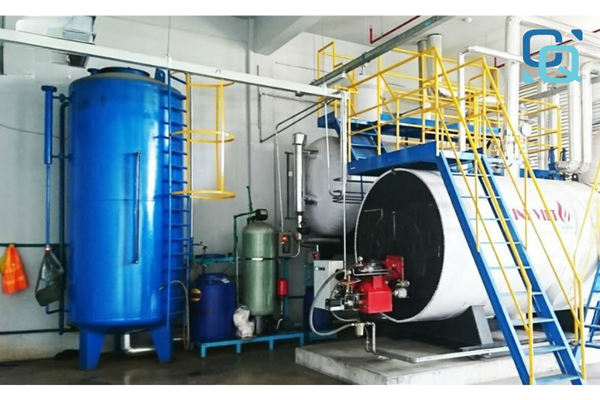
Industrial boiler (Steam Boiler) is a specialized device that converts water into steam at high temperature, Serves many production purposes such as operating steam turbines, drying system, heating, or steamed.
Imported boilers are widely used in business establishments, manufacturing factory, and even large industrial parks, meet the demand for thermal energy in many fields.
Structure of industrial boiler
An industrial boiler consists of the following main parts:
-
Steam system: Collect and control the amount of hot steam generated by the boiler.
-
Water supply system: Supply water into the boiler to create steam.
-
Fuel system: Fuel supply (like coal, husk, gas, oil) to burn, generate heat.
-
Control equipment and steam valves: Adjust boiler operation, ensure safety and effectiveness.
-
Combustion chamber: A place to store fuel for burning, with temperatures up to several hundred degrees Celsius.
-
Burner: Supply gas or fuel to maintain the combustion process.
-
Heat sensor: Automatically detect and adjust the temperature in the boiler.
-
Heat exchanger: Transfers heat from the combustion chamber to heat water, increase evaporation rate.
-
Expansion tank: Protects the boiler from excessive pressure.
-
Circulating pump system: Push hot water through pipes and return excess water to the tank.
-
Anti-backflow valve: Prevent backflow, Protects pumps and boilers.
-
Pipeline system: Includes supply curve (steam/hot water conduction) and the way back (Return cool water to the boiler).
Classification of industrial boilers
Depending on usage needs, Industrial boilers are divided into many types, Popular in Vietnam include:
-
Chain grate boiler: Use coal as main fuel.
-
Rice husk burning boiler: Utilize rice husks as an environmentally friendly fuel source.
-
Combination or multi-function boiler: Versatile for many uses.
-
Gas/DO oil/biomass fired boiler: Use gas or biomass fuel.
-
Thermal oil boiler: Specialized for industries requiring high temperatures.
Uses of imported industrial boilers
Industrial boilers are an important equipment in production, with main applications such as:
-
Providing steam for industrial kitchen systems, drying, or textile.
-
Food processing support, paper production, and heavy industries.
-
Provide heat energy for mechanical equipment that requires large amounts of heat.
-
Medical applications to sterilize drinking water or equipment, functional recovery support.
-
Used in heating systems or producing electricity through steam turbines.

HS Code of industrial boiler import
Importing industrial boilers, each type has its own HS Code, belongs to group 8402 (boiler that produces steam or other vapor) and 8403 (central heating water boiler). Determining the correct HS Code helps businesses calculate import taxes and comply with related policies. Below are some popular HS Codes:
|
Describe |
HS code |
Preferential import tax (%) |
|---|---|---|
|
Water tube boiler, capacity > 45 tons/hour, operates by electricity |
84021110 | 0 |
|
Water tube boiler, capacity > 45 tons/hour, do not use electricity |
84021120 | 0 |
|
Water tube boiler, Capacity 15-45 tons/hour, use electricity |
84021211 | 5 |
|
Water tube boiler, Capacity ≤ 15 tons/hour, use electricity |
84021219 | 5 |
|
Water tube boiler, Capacity 15-45 tons/hour, do not use electricity |
84021221 | 5 |
|
Water tube boiler, Capacity ≤ 15 tons/hour, do not use electricity |
84021229 | 5 |
|
Other boilers, capacity > 15 tons/hour, use electricity |
84021911 | 3 |
|
Other boilers, Capacity ≤ 15 tons/hour, use electricity |
84021919 | 3 |
|
Boiler water overheating, use electricity |
84022010 | 0 |
|
Boiler body/shell |
84039010 | 0 |
|
Other boiler parts |
84039090 | 0 |
Businesses need to carefully check the HS Code to ensure compliance with regulations and calculate costs accurately.
Necessary documents when importing boilers
Theo Circular 38/2015/TT-BTC (Amended by Circular 39/2018/TT-BTC), Boiler import documents included:
-
Application for quality inspection: For boilers with pressure above 0.7 bar.
-
Commercial invoice (Invoice): Details of value and quantity of goods.
-
Packing slip (Packing List): Information on packaging and number of packages.
-
Bill of lading (Bill of Lading): Sea or air shipping documents.
-
Quality certification (C/Q): Confirm product quality from the manufacturer.
-
Certificate of origin (C/O): If you want to enjoy tax incentives under a free trade agreement (FTA).
-
Inspection report (Test Report): Test results from the manufacturer or testing agency.
Process of importing industrial boilers
Detailed process
-
Step 1: Declare customs declaration
-
Prepare complete documents (contract, invoice, packing list, bill of lading, C/O, C/Q).
-
Determine the HS Code of the boiler to apply the correct tax rate and policy.
-
Enter declaration information into the customs system via software (like VNACCS).
-
-
Step 2: Open customs declaration
-
Print the declaration and bring the documents to the customs department to open the declaration.
-
Depending on the stream (green, Yellow, red), Carry out inspection steps as prescribed.
-
Sign up for quality testing (if applicable) theo Decision 1182/QD-BCT (06/04/2021).
-
-
Step 3: Clearance of declaration
-
If the profile is valid, Customs will accept customs clearance.
-
If there are errors, Businesses need to edit or supplement records.
-
Pay import tax and VAT to complete customs clearance.
-
-
Step 4: Bring goods to warehouse
-
After customs clearance, liquidate the declaration and carry out procedures to bring goods to the warehouse.
-
Notify the inspection center to check boiler quality and issue a standard/regulation conformity certificate.
-
For used boilers, Need further assessment of equipment age.
-
Check boiler quality
For boilers with rated working pressure above 0.7 bar, Enterprises must carry out quality inspection accordingly Decision 1182/QD-BCT. Inspection records included:
-
Application for quality inspection registration.
-
Commercial invoice (Invoice).
-
Packing slip (Packing List).
-
Inspection report (Test Report).
Quality inspection time usually takes approx 5 working days. Enterprises can perform checks via paper records or on the National Single Window System.
Check minimum power performance (MEPS)
According to regulations of the Ministry of Industry and Trade (from January 1, 2015), Industrial boilers must meet Minimum energy efficiency (MEPS) to be allowed to import and circulate. MEPS is the lowest energy efficiency standard that equipment must meet.
MEPS testing facility
Facilities designated for MEPS testing include:
-
Quatest 1, Quatest 2, Quatest 3 (Quality Measurement Standards Technical Center).
-
Industrial Testing and Inspection Center (Institute of Energy Mechanics & Mine, Vinacomin).
-
Intertek Testing Services LLC (Thailand).
-
Korea Testing Laboratory (KTL, Korea).
MEPS testing procedure
-
Step 1: Send a letter requesting testing
-
Send dispatch to testing facility, For example: Northern Electrical Experiment Company Limited (ETC1) in Hanoi.
-
Address: No. 465, Nguyen Van Linh, Phuc Dong, Long Bien, Hanoi.
-
-
Step 2: Get a quote
-
ETC1 will send a quote for energy efficiency testing to the business.
-
-
Step 3: Agree price and inspection schedule
-
The business confirms the quote, Announcement of test date, and send it back to ETC1.
-
-
Step 4: Field testing
-
After the boiler is installed and operating, ETC1 sent a working team to check the performance.
-
-
Step 5: Receive minutes of results
-
Test results are provided after about 1 week. Businesses pay service fees to receive minutes.
-
Legal basis
-
Official Dispatch 1592/TCHQ-GSQL (14/02/2015): Instructions for implementing MEPS.
-
Circular 07/2012/TT-BCT (04/04/2012): Energy labeling regulations.
-
Decision 51/2011/QD-TTg (12/09/2011): List of equipment must apply MEPS.
Cuong Quoc Logistics – A reputable boiler import support unit
Logistics power, established since 2011, is a leading unit in the field of logistics and import-export in Vietnam. With over a decade of experience, We are proud members of associations such as HLA, VLA, FIAT, and JCTRANS.
We provide services:
-
Shipping sea, air, and domestic.
-
Customs declaration and import and export entrustment.
-
Supports quality and energy efficiency testing.
-
International courier.
Cuong Quoc Logistics is committed to supporting businesses importing industrial boilers quickly, professional, and save costs. Contact now for advice:
Conclude
Procedures for importing industrial boilers require careful preparation of documents, Quality check, and comply with energy efficiency regulations. Hope the article from Logistics power has provided useful information for you to carry out the import process effectively. Contact us for detailed and professional support!
Cuong Quoc Freight Forwarding Company Limited
Office: 7th floor, Parami Building, 140 Bach Dang, Tan Son Hoa Ward, Ho Chi Minh City
Hotline: 0972 66 71 66
Email: info@cql.com.vn
Website: https://cql.com.vn/

See more at